
By Dr. Nguyen Vu Thuan & Mr Dang Hoang Huy
February 14, 2026

Overview
In today’s volatile, uncertain, competitive and dynamic business environment, traditional performance levers and metrics like incentives, management and efficiency alone no longer secure long-term success and sustained excellence. Instead, meaningful performance emerges from the interplay of purpose, passion, performance/growth, and self-awareness. Leading business thinkers and researchers have increasingly studied how these elements interact to drive individual and organizational excellence. Purpose is “doing what contributes value” and it connects work to value creation; Passion is “doing what you enjoy” and passion fuels sustained effort; performance and growth reflect measurable capability enhancement; and self-awareness allows ongoing alignment and adjustment. This article synthesizes insights from Harvard Business Review (HBR), academic journals, and research evidence to outline an actionable framework that transform from abstract concepts into a rigorous operating model for leaders, strategists, and negotiators.
The Process
The core mechanism of professional growth operates like a transmission system. It moves energy from a deep sense of “Why” into tangible “How.”
1. Purpose → Passion: “Why does my work matter?”
Purpose at work is the sense that one’s actions contribute to something larger than oneself—whether value delivered to customers, community, or organizational mission. Harvard research underscores that purpose is a strategic anchor for modern organizations, helping define culture, alignment, and long-term growth.
Management research highlights that aligning purpose with everyday work fosters intrinsic motivation and according to research by Nick Craig and Scott Snook (Harvard Business Review, “From Purpose to Impact”), executives who can clearly articulate their life’s purpose are more resilient and focused. Purpose acts as the “North Star,” providing the intrinsic motivation that external rewards (salary, status) cannot replicate. When an individual sees a direct line between their daily tasks and a higher objective—whether it’s solving a complex problem, helping others, or advancing a field—it triggers a neurological shift from “have to” to “want to.”
In a study spanning thousands of professionals, Morten T. Hansen found that highest performers were those who matched passion with purpose—a concept he labels “P-Squared.” Those with both purpose and passion consistently outperformed peers who had only one or neither.
Insights:
- Purpose drives value orientation (contribution to others) rather than merely personal enjoyment.
- Purpose gives context: why work matters, and how it aligns with broader organizational strategy.
- Purpose is the potential energy that sits waiting to be converted into kinetic energy (Passion). Without a clear “Why,” there is no fuel for the engine.
2. Passion → Performance & Growth: “How am I becoming more capable over time?”
Passion builds on purpose to sustain effort and resilience. Academic research on entrepreneurial passion shows that passion enhances performance by directing focused effort on goals and by promoting learning behavior, persistence, and adaptive capability in complex environments.
Harvard Business Review and emotional intelligence studies also emphasize that passion—when regulated and aligned with organizational values—supports high motivation and performance. Passion without purpose, however, can lead to narrow focus or burnout; conversely, purpose without passion may lack the drive for innovation and growth.
Insights:
- Passion enables deep engagement, leading to improved skills and performance outcomes.
- Organizations that foster passion through challenge, feedback, and meaningful work see stronger performance growth.
3. Purpose → Performance & Growth: “What naturally excites and absorbs me?”
When purpose is lived—not just espoused—through strategy and everyday decision-making, it becomes a performance multiplier. For example, research on creating shared value shows how aligning strategy with broader societal goals can enhance innovation, reputation, and growth at scale.
Purpose shapes strategic intent and offers direction that helps individuals and organizations invest energy in the right priorities, enabling accelerated capability development and competitive advantage.
Top researchers like Teresa Amabile (HBR, “The Power of Small Wins”) have found that the single biggest predictor of positive inner work life is making progress in meaningful work. When an individual asks, “What naturally excites and absorbs me?”, they are identifying their zone of genius. This is where Purpose (Meaning) bypasses friction and converts directly into Performance (Output). This alignment reduces “cognitive drag,” allowing leaders to execute complex strategies with seemingly effortless energy.
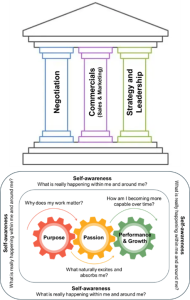
Self-Awareness: The Thread Across Purpose, Passion, and Performance
The core encompasses this process is self-awareness—the ability to observe and understand one’s values, emotions, strengths, and impact on others. Our research on self-awareness identifies it as a foundational capability that dramatically improves decision-making, leadership effectiveness, and personal growth.
Organizational psychologist Tasha Eurich, in her research for HBR (“What Self-Awareness Really Is”), distinguishes between two types:
- Internal Self-Awareness: represents how clearly we see our own values, passions, aspirations, fit with our environment, reactions (e.g., “Am I angry because the deal is bad, or because my ego is bruised?”) (including thoughts, feelings, behaviors, strengths, and weaknesses), and impact on others. She has found that internal self-awareness is associated with higher job and relationship satisfaction, personal and social control, and happiness; it is negatively related to anxiety, stress, and depression
- External Self-Awareness: Understanding how others view you. (e.g., “Do my team members see my passion as inspiring or overwhelming?”). It means understanding how other people view us, in terms of those same factors listed above. Her research shows that people who know how others see them are more skilled at showing empathy and taking others’ perspectives. For leaders who see themselves as their employees do, their employees tend to have a better relationship with them, feel more satisfied with them, and see them as more effective in general.
A lack of self-awareness is the primary reason high-potential leaders derail. They may have Purpose and Passion, but if they cannot read the room or regulate their own emotional wake, they destroy value rather than create it. Self-awareness allows a leader to calibrate their intensity, ensuring their passion fuels the team rather than scorching it.
Most importantly, without self-awareness, alignment between purpose and passion is unstable, leading to performance plateaus, burnout, or misaligned strategy execution.
How to Cultivate It (Key self-aware practices):
- Reflective journaling or assessments to uncover values and motivations.
- Seeking feedback for blind-spot reduction and external perspective.
- Monitoring emotional and cognitive responses to work challenges to keep goals aligned with purpose.
Leaders who focus on building both internal and external selfawareness, who seek honest feedback from loving critics, and who ask what instead of why can learn to see themselves more clearly—and reap the many rewards that increased self-knowledge delivers. And no matter how much progress we make, there’s always more to learn. That’s one of the things that makes the journey to self-awareness so exciting.
Better Performance & Growth in Core Business Areas
1) Negotiation
Negotiation becomes more effective when driven by a purpose that transcends zero-sum thinking into a value – creation collaborative process. Self-awareness enables negotiators to manage emotions, understand counterparties’ motivations, and create mutually beneficial outcomes. Emotional intelligence research highlights these competencies as critical negotiation skills.
The Perspective Taking & Empathetic Dealmaker
In negotiation, self-awareness and purpose are critical assets. Research by Deepak Malhotra and Max Bazerman (Negotiation Genius) highlights that successful negotiators do not just focus on price; they focus on the interests (Purpose) behind the positions.
A self-aware negotiator asks, “What is the other party’s ‘Why’?” By understanding the purpose driving the other side, you can craft solutions that satisfy their core needs while achieving your own, moving from zero-sum battling to value creation. It helps performance shift from “Winning the argument” to “Solving the problem collaboratively.”
2) Commercial Sales & Marketing
Sales professionals with passion and purpose demonstrate higher proactivity, resilience, and customer focus. Studies in sales contexts show how passion motivates proactive behaviors that are linked to long-term sales performance. Marketing that articulates shared purpose tends to engage customers more deeply and differentiate brands.
Authentic Connection
The era of “feature-selling” is not enough anymore. The “Purpose to Passion” link is vital besides strong features. As Simon Sinek argued, “People don’t buy what you do; they buy why you do it.”
High-performing sales professionals use self-awareness to manage their own rejection resilience (Growth Mindset). In Marketing, connecting the brand’s Purpose to the consumer’s identity creates loyalty beyond price. Harvard research indicates that “Purpose-driven brands” significantly outperform the market because they align with the customer’s values.
This helps performance shift from “Selling products” to “Enabling customer success.”
3) Strategy
Purpose must anchor strategy to sustain growth. The concept of creating shared value demonstrates how strategic alignment with broader societal outcomes can enhance competitive advantage and innovation—turning purpose into performance drivers.
Purpose as the North Star
In strategy, Purpose acts as a filter for decision-making. Michael Porter and Mark Kramer’s concept of Creating Shared Value (CSV) argues that the most competitive strategies are those that align business success with societal progress.
When a company’s strategy is disconnected from its Passion or Capabilities (Performance), it fails. A self-aware leadership team uses the “Gear” model to ask: “Does this strategy excite us? Do we have the capability to grow into it? Does it align with our core purpose?” If the answer to any is no, the strategy is flawed.
This helps performance shift from “Opportunistic pivots” to “Disciplined evolution.”
4) Leadership
Leaders exemplifying self-awareness, purpose, and passion set the tone for organizational culture. Daniel Goleman’s work, featured in HBR, identifies emotional intelligence—especially self-awareness and motivation—as core competencies of effective leaders.
Authentic and Adaptive Leadership
Bill George’s research on Authentic Leadership posits that leaders cannot be effective if they are “acting.” They must draw on their own life story (Purpose) to lead with conviction (Passion).
A leader practicing this framework uses Self-Awareness to monitor their impact. They ask: “How am I becoming more capable over time?” not just for themselves, but for their teams. They transform from commanders to coaches, using their passion to ignite the purpose in others.
This helps performance shift from “Directing tasks” to “Developing people.”
Conclusion
Purpose, passion, performance, and growth are not isolated constructs but an interwoven process, strengthened by self-awareness. Leaders and professionals who understand why their work matters, cultivate what energizes them, and continuously develop capability through feedback and reflection unlock sustained performance and growth. Applying these principles across negotiation, sales/marketing, strategy, and leadership fosters not just individual success but organizational resilience and innovation.
References
Hansen, M. (n.d.). Purpose, meaning, and passion: What research says leads to high performance. Harvard Business Review.
Harvard Business Review Press. (2019). HBR guide to self-awareness & leadership. Harvard Business Review Press.
Entrepreneurial passion and venture performance: A framework. (n.d.). Management Research Review.
Linking passion to performance in social commerce contexts. (n.d.). Journal article.
Porter, M. E., & Kramer, M. R. (2011). Creating shared value. Harvard Business Review, 89(1–2), 62–77.
Goleman, D. (1998). What makes a leader? Harvard Business Review, 76(6), 93–102.
Harvard Business Review. (n.d.). Purpose, meaning, and passion. HBR Emotional Intelligence Series.
Craig, N., & Snook, S. (2014). From purpose to impact. Harvard Business Review, 92(5), 104–111.
Eurich, T. (2018). What self-awareness really is (and how to cultivate it). Harvard Business Review, 96(1), 124–133.
Vallerand, R. J., Blanchard, C., Mageau, G. A., Koestner, R., Ratelle, C., Léonard, M., Gagné, M., & Marsolais, J. (2003). Les passions de l’âme: On obsessive and harmonious passion. Journal of Personality and Social Psychology, 85(4), 756–767.
Amabile, T. M., & Kramer, S. J. (2011). The power of small wins. Harvard Business Review, 89(5), 70–80.
George, B., Sims, P., McLean, A. N., & Mayer, D. (2007). Discovering your authentic leadership. Harvard Business Review, 85(2), 129–138.
Malhotra, D. (2015). Control the negotiation before it begins. Harvard Business Review, 93(12), 96–104.