
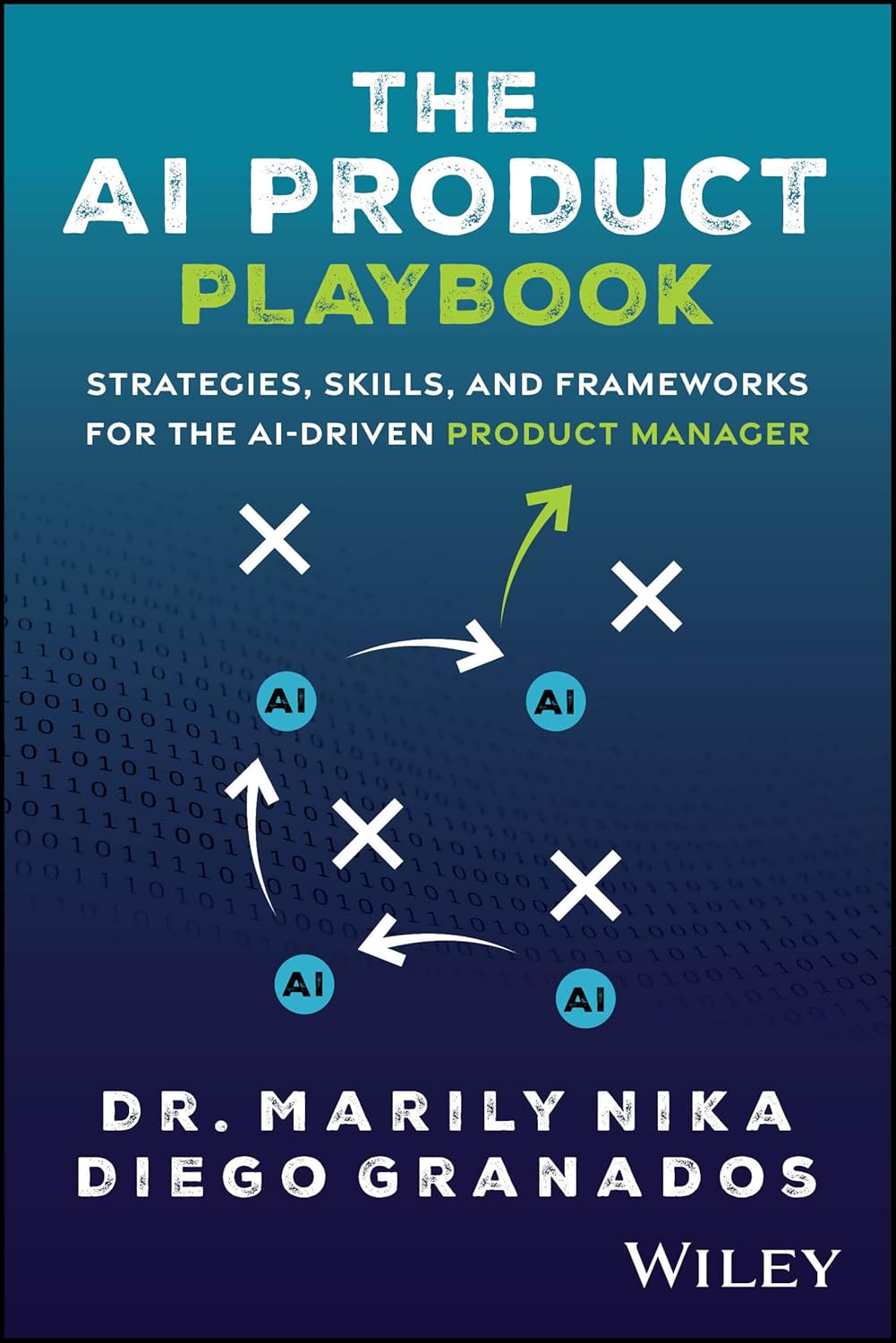
The AI Product Playbook: Strategies, Skills, and Frameworks for the AI-Driven Product Manager
The AI Product Playbook arrives at a moment when artificial intelligence has moved from novelty to necessity, and from experimentation to accountability. Marily Nika and Diego Granados write not for those dazzled by AI’s promise, but for product leaders tasked with turning that promise into durable value.
Rather than treating AI as a technological breakthrough in isolation, the authors frame it as a product discipline. The book is organized around the full lifecycle of AI-driven products, from opportunity discovery and problem framing to deployment, scaling, and governance. Its central argument is deceptively simple: success in AI products depends less on how advanced a model is, and more on how wisely it is applied.
One of the book’s most compelling contributions is its insistence on proportionality. Not every problem requires machine learning, and not every machine learning solution requires maximal complexity. In many real-world settings, systems that are interpretable, stable, and operationally sound outperform more sophisticated models that are difficult to explain or maintain. This restraint feels refreshing in an industry often enamored with technical ambition for its own sake.
Nika and Granados also redefine the role of the product manager in an AI context. The AI PM is no longer merely a coordinator of features, but a steward of decisions that carry ethical, experiential, and organizational consequences. Questions of bias, accountability, and trust are treated not as peripheral concerns, but as core product responsibilities.
What distinguishes The AI Product Playbook is its pragmatism. It avoids evangelism and instead offers frameworks that acknowledge uncertainty, trade-offs, and human judgment. AI is presented not as a replacement for decision-making, but as something that amplifies both good and bad choices.
In the end, The AI Product Playbook is less about building intelligent systems than about building wise ones. It is a book for product managers who understand that in the age of AI, the hardest problems are not technical, but human.