
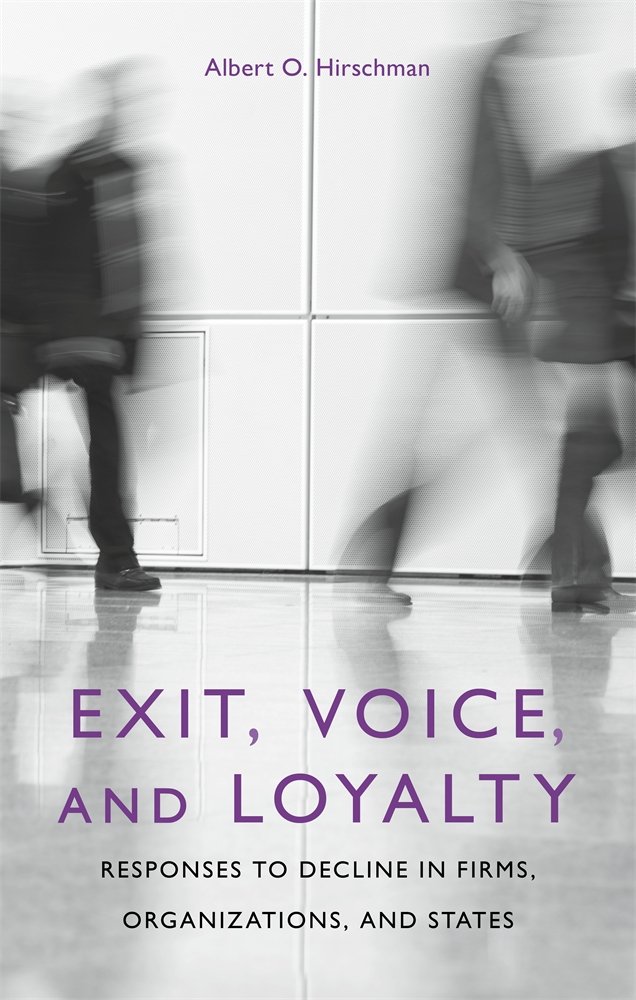
Exit, Voice, and Loyalty: Responses to Decline in Firms, Organizations, and States
Exit, Voice, and Loyalty by Albert O. Hirschman is a brief work with an unusually wide reach. Its central concern is not markets in the abstract, but behavior under disappointment — what individuals do when institutions fail them.
Hirschman’s answer is elegantly spare. Faced with decline, people either exit or use voice. Exit is withdrawal — leaving a company, abandoning a product, disengaging from a system. Voice is expression — complaint, protest, feedback, or any attempt to improve conditions from within. Between them sits loyalty, a moderating force that delays exit and makes voice more likely by binding individuals to the institution in question.
The insight is not merely classificatory. Hirschman explores the tension between these responses, noting that each can undermine the other. Easy exit, for instance, may weaken voice by allowing the most engaged participants to leave rather than repair. Conversely, strong loyalty can sustain voice but may also prolong tolerance of decline.
What gives the book its durability is its portability. The framework applies as readily to politics and organizations as it does to firms and markets. Employees decide whether to resign or speak up. Citizens choose between withdrawal and participation. In each case, the balance between exit and voice shapes the trajectory of the institution itself.
Hirschman resists prescribing solutions. Instead, he offers a lens — one that clarifies how systems deteriorate and, occasionally, how they recover. Exit, Voice, and Loyalty endures because of that clarity. It distills complex social behavior into a structure that is at once simple, flexible, and quietly profound.