
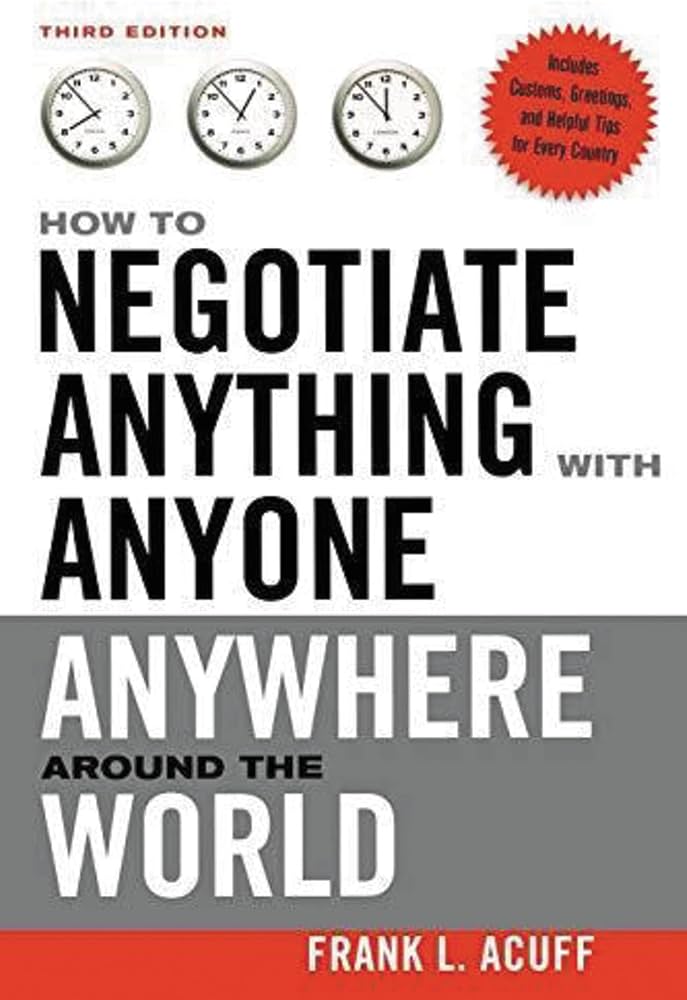
How to Negotiate Anything with Anyone Anywhere Around the World
Frank Acuff’s How to Negotiate Anything with Anyone Anywhere Around the World approaches negotiation with a rare degree of pragmatism. Rather than advancing a grand theory or academic model, the book treats negotiation as a survival skill in a globalized world, where cultural differences often matter more than logic or numbers.
The book’s central insight is that negotiation never occurs in a vacuum. Every exchange is shaped by social context, cultural norms, and differing perceptions of power. A strategy that works smoothly in the United States or Western Europe may fail outright in Asia, the Middle East, or Latin America. Acuff does not romanticize these differences; he treats them as essential information that must be read and interpreted with care.
One of the book’s strongest contributions is its emphasis on relationships. In many cultures, trust and personal connection are not optional preliminaries but prerequisites for negotiation itself. Acuff argues that many failed deals collapse not over terms, but because negotiators move too quickly, speak too directly, or unknowingly violate unspoken rules.
The book is equally perceptive in its discussion of power. Acuff expands the concept beyond money or formal authority to include patience, control of information, and cultural fluency. In international negotiations, he suggests, understanding the rules of the game often outweighs the attractiveness of the offer on the table.
How to Negotiate Anything with Anyone Anywhere Around the World is not a book for readers seeking shortcuts. It is better suited to managers, entrepreneurs, and professionals operating across borders, who recognize negotiation as a subtle social craft. Its enduring reminder is simple but demanding: successful negotiation depends less on what you say than on how deeply you understand the person across the table.