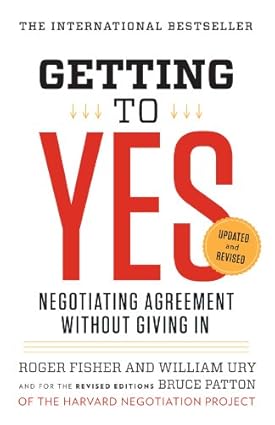
Getting to Yes: Negotiating Agreement Without Giving In
Published by the Harvard Negotiation Project, Getting to Yes reshaped the modern understanding of negotiation. Before its arrival, bargaining was often framed as a battle of wills, where one side’s gain necessarily meant the other’s loss. This book offers a different premise: separate the people from the problem, and focus on underlying interests rather than rigid positions.
The enduring strength of Getting to Yes lies in its disciplined simplicity. Rather than prescribing clever tactics, it presents a framework that applies equally to boardrooms and everyday life. When negotiators argue over numbers, they are often defending unspoken fears, expectations, or constraints. By uncovering these underlying interests, the book suggests, agreement becomes possible without capitulation.
One of its most influential ideas is the use of objective criteria. Instead of relying on pressure or persuasion, Fisher and his co-authors argue for grounding negotiations in independent standards such as market value, precedent, or expert opinion. This approach not only increases the perceived fairness of an agreement, but also preserves relationships once the deal is done.
At the same time, the book’s cooperative tone has occasionally led to misinterpretation. Getting to Yes does not advocate being agreeable at all costs. It assumes careful preparation, a clear understanding of one’s alternatives, and the discipline to walk away when necessary. Cooperation, in this context, is strategic rather than naive.
Getting to Yes does not promise victory in every negotiation. What it offers instead is something more durable: a method for reaching sustainable agreements, reducing unnecessary conflict, and maintaining personal integrity. In an interconnected world, that philosophy has proven not only humane, but profoundly practical.