
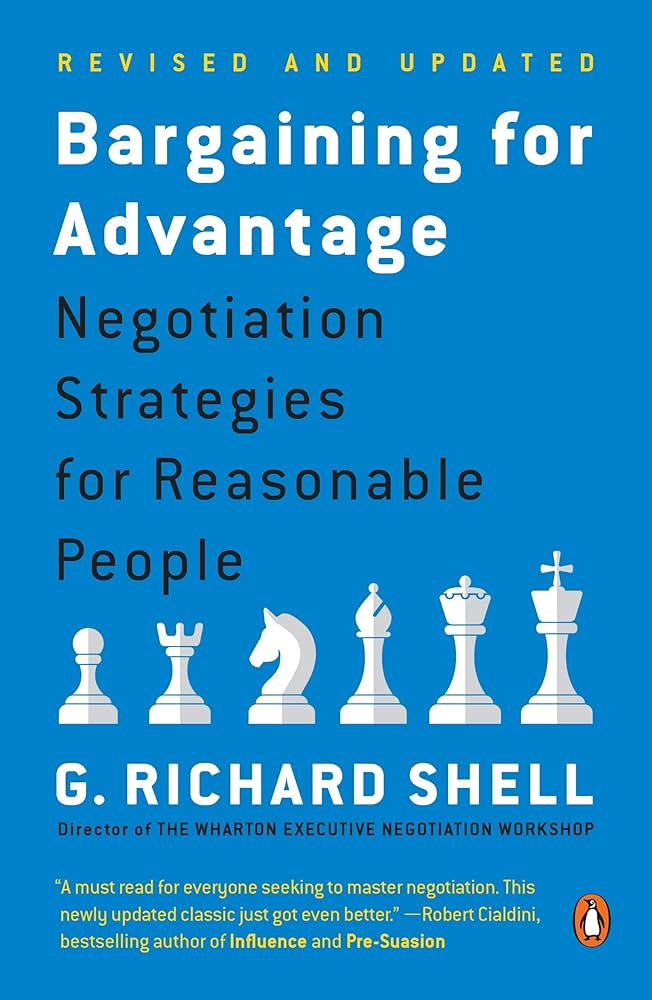
Bargaining for Advantage: Negotiation Strategies for Reasonable People
Few negotiation books begin with such a quietly radical premise: you do not have to be ruthless to be effective. In Bargaining for Advantage, G. Richard Shell offers a measured, intellectually grounded alternative to the mythology of hardball bargaining, arguing that lasting advantage is built on reason, preparation, and self-awareness rather than intimidation or tactical aggression.
At its core, the book is not a manual of tricks. Shell does not promise domination across the table. Instead, he asks a more enduring question: where does real bargaining power come from, and how can it be exercised without sacrificing credibility, relationships, or personal integrity. Drawing on economics, law, and behavioral psychology, he frames negotiation as a disciplined process—one that rewards those who think strategically about context, incentives, and human behavior.
One of the book’s most distinctive contributions is its emphasis on individual negotiation styles. Shell contends that negotiators bring deeply ingrained values and instincts to the table, shaping how they perceive risk, fairness, and conflict. Rather than prescribing a single “correct” approach, he helps readers identify their own natural style and align strategy accordingly. This focus on self-diagnosis marks a departure from formulaic negotiation models and gives the book a rare sense of realism.
Equally compelling is Shell’s treatment of power. He draws a careful distinction between power that actually exists and power that is merely perceived, showing how misjudgments on either side often derail otherwise winnable negotiations. Through case studies from business and legal settings, he demonstrates how advantage is frequently created through control of information, credible standards, and the judicious balance between firmness and flexibility—all grounded in reason rather than coercion.
What makes Bargaining for Advantage especially relevant today is its restraint. In an era that often equates negotiation with zero-sum combat, the book argues persuasively that the most durable outcomes are achieved by negotiators who combine self-interest with legitimacy, and strength with trustworthiness. It teaches not only how to reach better agreements, but how to become a negotiator others are willing to engage with again.
This is a book for readers who seek long-term advantage, not fleeting victories. More importantly, it is for those who still believe that reason, when properly deployed, remains the most powerful tool at the negotiating table.

G. Richard Shell is the Thomas Gerrity Professor of Legal Studies, Business Ethics, and Management at the Wharton School of Business at the University of Pennsylvania. His latest book, The Conscience Code: Lead with Your Values. Advance Your Career (HarperCollins Leadership), shows readers how to stand up for their core beliefs when the pressure is on to look the other way. His award-winning Bargaining for Advantage: Negotiation Strategies for Reasonable People (Penguin) is now in its third edition in multiple languages, and Springboard: Launching Your Personal Search for Success (Portfolio 2013) was named Business Book of the Year in the USA and was short-listed for Management Book of the Year by the British Library. He is also author of The Art of Woo: Using Strategic Persuasion to Sell Your Ideas (Portfolio 2007) (with Mario Moussa) and Make the Rules or Your Rivals Will (Crown Business 2004). He serves as Director of Wharton’s Executive Negotiation Workshop and Strategic Persuasion Workshop. He has won multiple teaching and scholarly awards, had his work cited by the United States Supreme Court, and taught people from all walks of professional life, from Silicon Valley entrepreneurs and Fortune 500 CEOs to FBI hostage negotiators, Navy SEALs, and United Nations peacekeepers.