
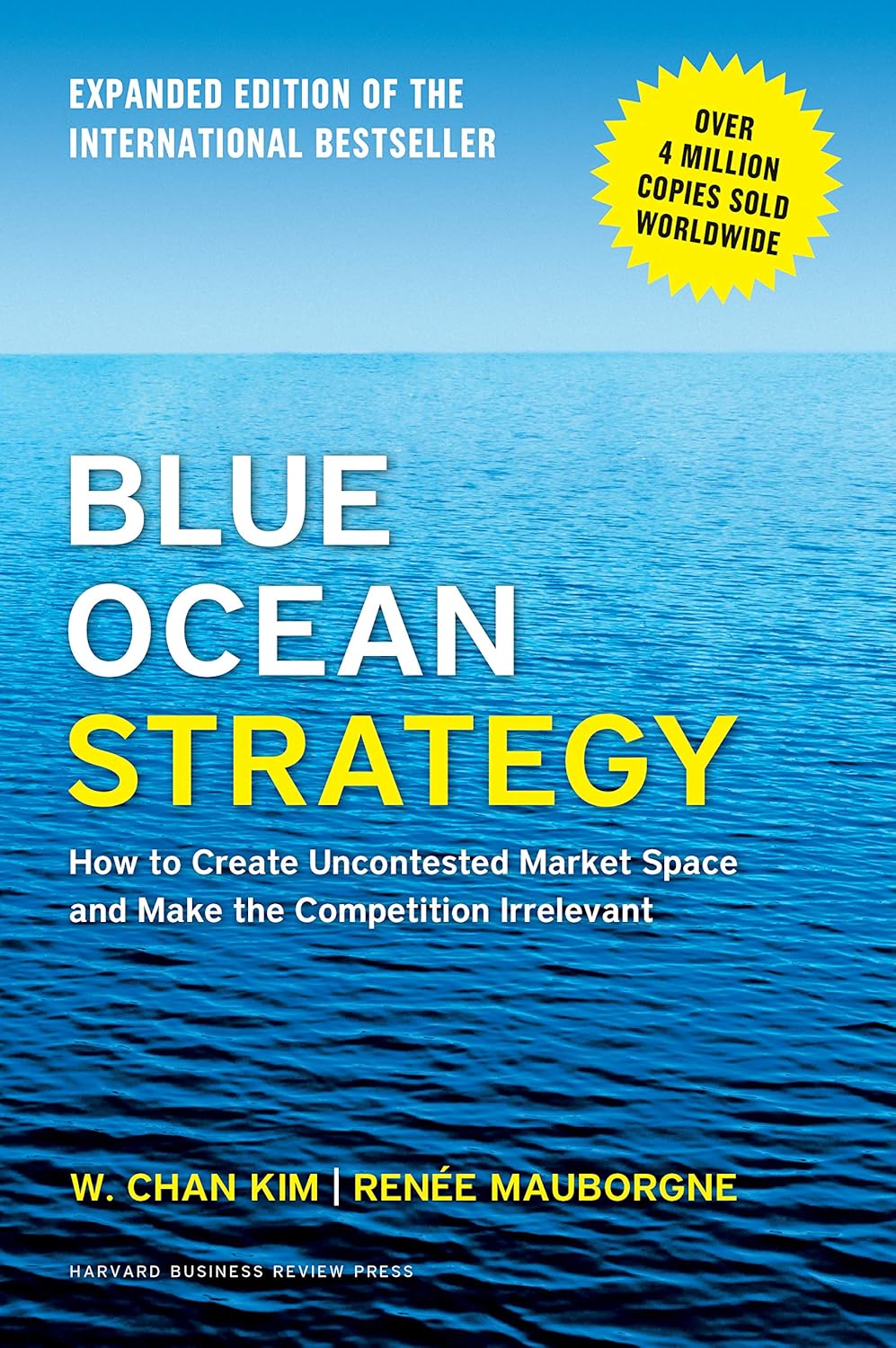
Blue Ocean Strategy, Expanded Edition: How to Create Uncontested Market Space and Make the Competition Irrelevant
Blue Ocean Strategy (Expanded Edition) by W. Chan Kim and Renée Mauborgne is not a manual for winning competitive battles. It is a quiet but radical invitation to stop fighting altogether. At a time when strategy is often reduced to outperforming rivals within shrinking markets, the book asks a more unsettling question: what if competition itself is the wrong starting point?
The authors draw a sharp distinction between “red oceans,” where firms compete head-to-head over existing demand, and “blue oceans,” where new demand is created and rivalry becomes irrelevant. Growth, they argue, does not come from incremental improvements within industry boundaries, but from redefining value in ways that reshape those boundaries altogether. Case studies such as Cirque du Soleil or Nintendo Wii are not presented as heroic anomalies, but as evidence of a repeatable strategic logic.
What gives the book its lasting influence is its discipline. Concepts like value innovation, the strategy canvas, and the four actions framework are not tools for operational efficiency; they are instruments of strategic clarity. They force leaders to confront uncomfortable trade-offs: which industry assumptions must be eliminated, which taken-for-granted features reduced, and which neglected elements elevated or created anew. The expanded edition addresses a common misconception by emphasizing that blue oceans are not born from reckless creativity, but from systematic reconfiguration of existing realities.
Blue Ocean Strategy remains compelling because it does not promise easy victories. Instead, it offers a way out of the exhausting cycle of imitation and price competition. For leaders facing saturated markets and eroding margins, the book functions less as a playbook and more as a reframing device. It suggests that the most decisive strategic move may not be to fight harder, but to choose a different ocean altogether.