
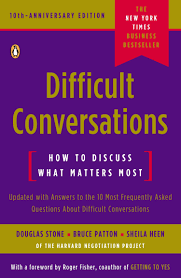
Difficult Conversations: How to Discuss What Matters Most
Some books teach you how to speak more persuasively. Difficult Conversations teaches you why, even with the best intentions, we so often speak past one another. Rather than offering surface-level communication tactics, the book goes straight to the heart of what makes conversations hard: the stories we tell ourselves, the emotions we suppress, and the quiet threats each exchange poses to our sense of identity.
The book’s central insight is deceptively simple. Every difficult conversation, the authors argue, contains three conversations unfolding at once. There is the conversation about what happened, in which each side believes they are describing objective reality. There is the conversation about feelings, frequently unspoken yet powerfully present. And there is the conversation about identity, where the stakes are nothing less than what the interaction implies about who we are. When these layers go unrecognized, even the most carefully chosen words tend to fail.
What distinguishes Difficult Conversations is its refusal to frame communication as a choice between toughness and empathy. Instead, it calls for a disciplined shift in mindset: from proving oneself right to cultivating informed curiosity. The authors invite readers to replace the question “Who’s right?” with the far more productive “How did each of us come to see things this way?” This reframing does not dilute one’s position; it makes it possible to express it without shutting down the conversation altogether.
The enduring value of the book lies in its realism. It does not promise to eliminate conflict, nor does it romanticize openness. Rather, it shows that avoiding hard conversations often deepens the very problems we fear, while confronting them without reflection tends to escalate them. What it offers instead is a framework for entering conflict with clarity, self-awareness, and a genuine chance of being heard.
This is a book for people dealing with real relationships and real consequences: managers giving difficult feedback, partners navigating disagreement, families wrestling with unmet expectations, and individuals trying to speak honestly without causing unnecessary harm. It does not make difficult conversations comfortable. It makes them possible—and that is precisely why it matters.