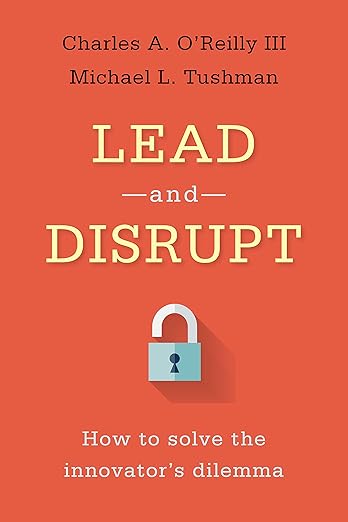
Lead and Disrupt_ How to Solve the Innovator’s Dilemma
In Lead and Disrupt: How to Solve the Innovator’s Dilemma, Charles O’Reilly and Michael Tushman move the conversation about innovation away from ideas and technologies and place it squarely where it belongs: inside the organization itself.
Building on Clayton Christensen’s foundational insight, the authors argue that disruption is not primarily a technological problem, but a leadership and organizational one. Most companies fail to adapt not because they lack awareness or creativity, but because their existing structures, incentives, and cultures are designed to optimize the present, not to invent the future.
At the heart of the book is the concept of the ambidextrous organization, capable of simultaneously exploiting current businesses while exploring disruptive opportunities. This duality is not a matter of balance but of deliberate separation, supported by senior leadership. New ventures must be protected from the performance metrics, processes, and financial expectations that govern the core business.
What distinguishes Lead and Disrupt from much of the innovation literature is its refusal to romanticize disruption. O’Reilly and Tushman show that slogans about innovation culture and entrepreneurial mindset are insufficient. Sustainable innovation requires disciplined organizational design and leaders willing to tolerate tension, ambiguity, and short-term inefficiency.
The book places particular responsibility on top leadership. Ambidexterity cannot be delegated. It demands CEOs who are willing to personally sponsor exploratory initiatives, manage internal conflict, and resist the gravitational pull of short-term performance pressures.
Ultimately, Lead and Disrupt is a sobering and practical guide for leaders of established organizations facing technological and market transitions. It offers no easy formulas, but a clear message: the greatest threat to successful companies is not disruption itself, but their inability to lead through it.