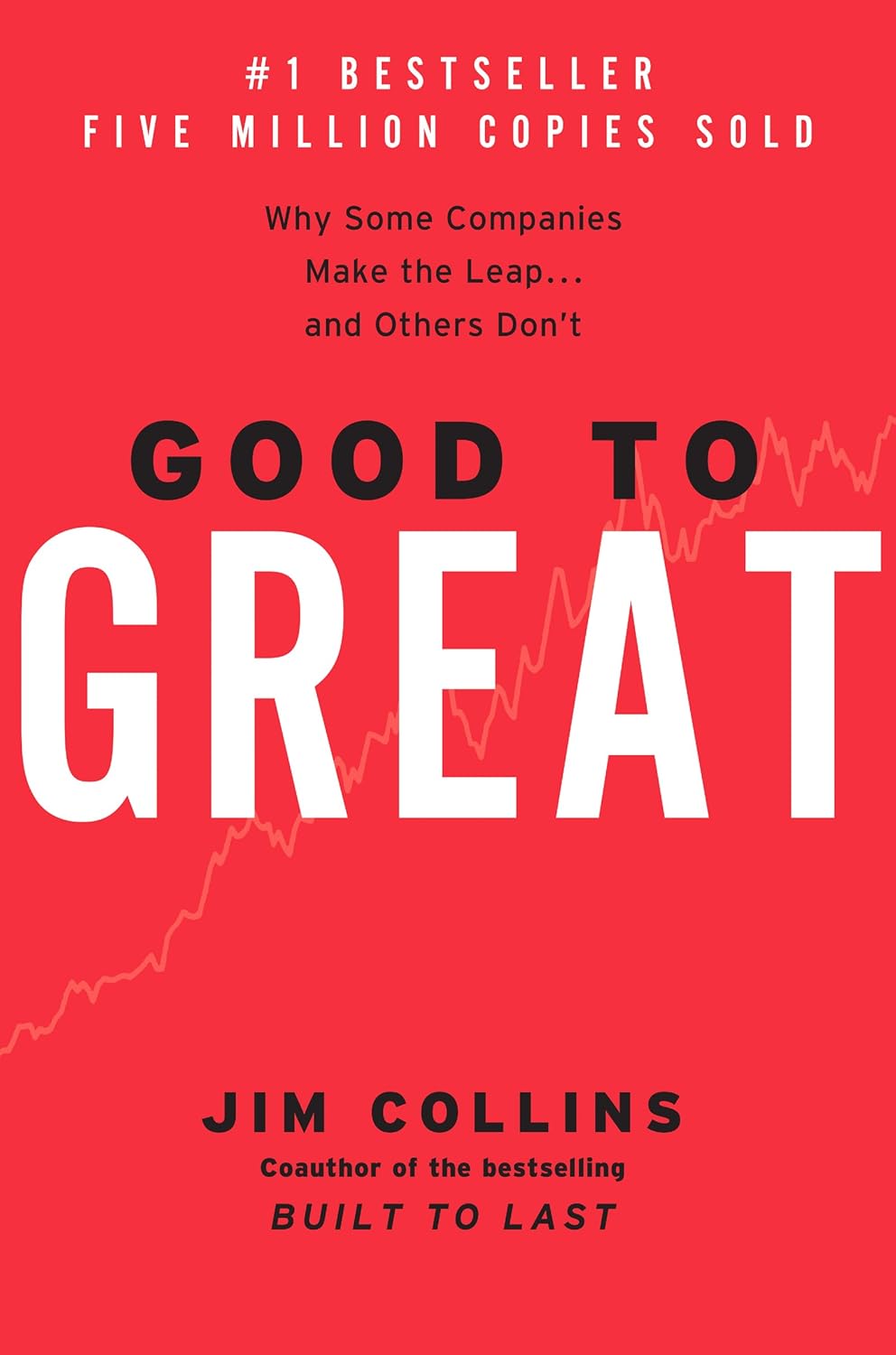
Good to Great: Why Some Companies Make the Leap…and Others Don’t

By Jim Collins
Năm sản xuất : 2001
Thể loại sách : Non-fiction

Category:
Few business books have aged as quietly — and as convincingly — as Good to Great by Jim Collins. Rather than chasing anecdotes of success, Collins builds his argument on disciplined research, asking a deceptively simple question: why do some companies plateau at adequacy while others make the leap to sustained excellence? What emerges is not a celebration of charisma or bold vision, but a reframing of leadership itself. Collins introduces the idea of “Level 5 Leadership,” a form of leadership defined less by personality than by paradox — humility paired with fierce professional will. It is a quiet kind of authority, often invisible from the outside, yet foundational to enduring success. Equally striking is the book’s insistence that strategy does not begin with direction, but with people. The principle of “First Who, Then What” challenges a deeply ingrained instinct to prioritize vision over team. Collins argues, instead, that the right people, placed in the right roles, will shape the right path over time — a claim that feels counterintuitive until one considers how often strategy fails not in design, but in execution. At the conceptual center of the book lies the “Hedgehog Concept,” a framework of disciplined focus at the intersection of passion, capability, and economic engine. It is less about ambition than about clarity — a refusal to be distracted by opportunities that fall outside a company’s core truth. Perhaps the most sobering insight comes from what Collins calls the “Flywheel Effect.” Greatness, he suggests, is not the product of a single breakthrough, but of cumulative effort — small, consistent pushes that, over time, build unstoppable momentum. It is an idea that stands in stark contrast to the modern fixation on rapid, dramatic success. Good to Great is worth reading not because it promises transformation, but because it dismantles illusion. It replaces the mythology of overnight success with something far less glamorous and far more durable: disciplined thinking, the right people, and the patience to let momentum do its work.
Jim Collins is a student and teacher of exceptional human endeavor and a Socratic advisor to leaders across all sectors of society.

Having invested more than three decades in rigorous research, he has authored or coauthored a series of books that have sold in total more than 11 million copies worldwide, including the #1 bestseller Good to Great, the enduring classic Built to Last, and other highly-influential writings such as Great by Choice, How the Mighty Fall, Beyond Entrepreneurship, Good to Great and the Social Sectors, and Turning the Flywheel.

In recent years, Jim has broadened the scope of his work, extending out from the question of what makes great companies tick to the study of remarkable people and their lives. His newest book (available April 2026) tackles the big question implicit in its title: What to Make of a Life. Grounded in a ten-year research project, it offers transformative lessons on constructing—and reconstructing—a life through the cliff moments and transitions we all will face repeatedly in our lives.

Through his research, Jim seeks to uncover timeless principles on which people can reliably depend. Concepts that emerged from Jim’s earlier work have become part of the leadership lexicon, such as: Level 5 leadership, First Who (the right people on the bus), the Hedgehog Concept, the Flywheel, 20 Mile March, Preserve the Core/Stimulate Progress, and BHAGs (Big Hairy Audacious Goals). His writings and teachings have had a lasting impact and proved integral to the building of many great organizations.

Driven by a relentless curiosity, Jim began his research and teaching career on the faculty at the Stanford Graduate School of Business, where he received the Distinguished Teaching Award in 1992. In 1995, he founded a management laboratory in Boulder, Colorado, where he conducts research and engages with CEOs and senior-leadership teams.

Jim has a passion for learning and teaching in the social sectors, including education, healthcare, government, faith-based organizations, social ventures, and cause-driven nonprofits. In 2012 and 2013, he had the honor to serve a two-year appointment as the Class of 1951 Chair for the Study of Leadership at the United States Military Academy at West Point.

He holds a bachelor’s degree in mathematical sciences and an MBA from Stanford University, and honorary doctoral degrees from the University of Colorado and the Peter F. Drucker Graduate School of Management at Claremont Graduate University. In 2017, Forbes selected Jim as one of the 100 Greatest Living Business Minds.