
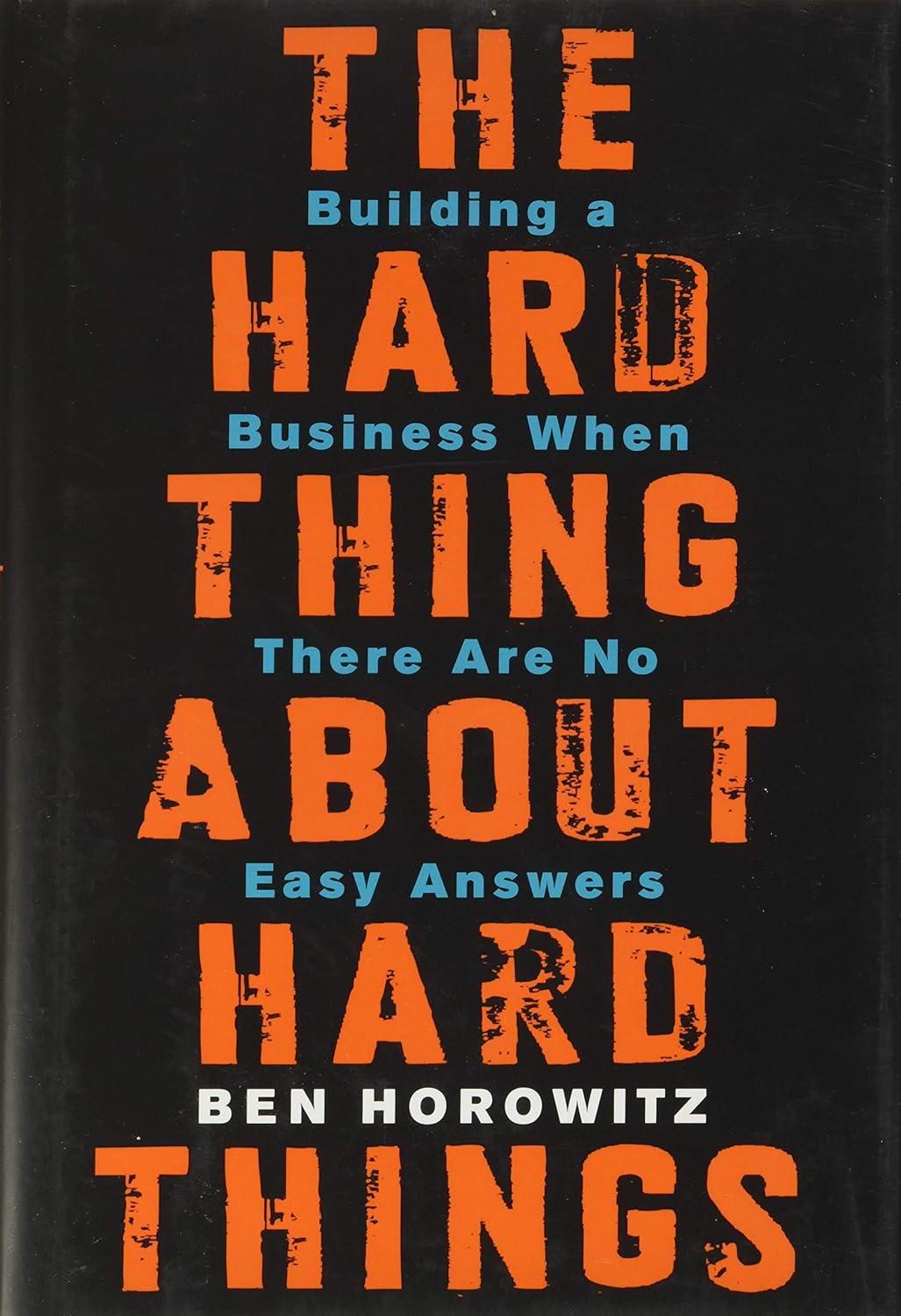
The Hard Thing About Hard Things: Building a Business When There Are No Easy Answers
In The Hard Thing About Hard Things, Ben Horowitz dismantles the mythology of leadership as a sequence of rational, well-informed decisions. What remains is something far less orderly and far more honest: leadership as a series of difficult choices made under pressure, often with incomplete information and no clearly favorable outcome.
Horowitz’s account stands apart from conventional business literature in its refusal to romanticize success. Instead, it lingers in the moments most narratives omit — the near failures, the financial crises, the personnel decisions that fracture relationships. These are not edge cases; they are, as Horowitz suggests, the defining experiences of leadership.
At the center of the book is a redefinition of what it means to lead. Leadership is not about projecting certainty, but about confronting uncertainty without denial. When a company faces existential threat, the role of the CEO is stripped of abstraction. It becomes a matter of endurance, judgment, and the willingness to act despite doubt.
What gives the book its weight is its acknowledgment that many of the hardest decisions resist codification. There are no clean frameworks for firing a close colleague, navigating internal dissent, or deciding whether to persist or surrender. Horowitz does not offer formulas; instead, he provides a vocabulary for understanding the emotional and ethical dimensions of these decisions.
The book’s lasting relevance lies in its candor. By rejecting the illusion of control, it presents leadership as an inherently human endeavor — shaped by fear, resilience, and responsibility. It suggests that the defining quality of a leader is not the ability to avoid difficulty, but the capacity to remain functional within it.
The Hard Thing About Hard Things endures because it speaks to a reality many leaders recognize but few articulate: the hardest problems are hard precisely because they have no good answers. In that space, leadership is less about knowing what to do, and more about having the resolve to do something at all.