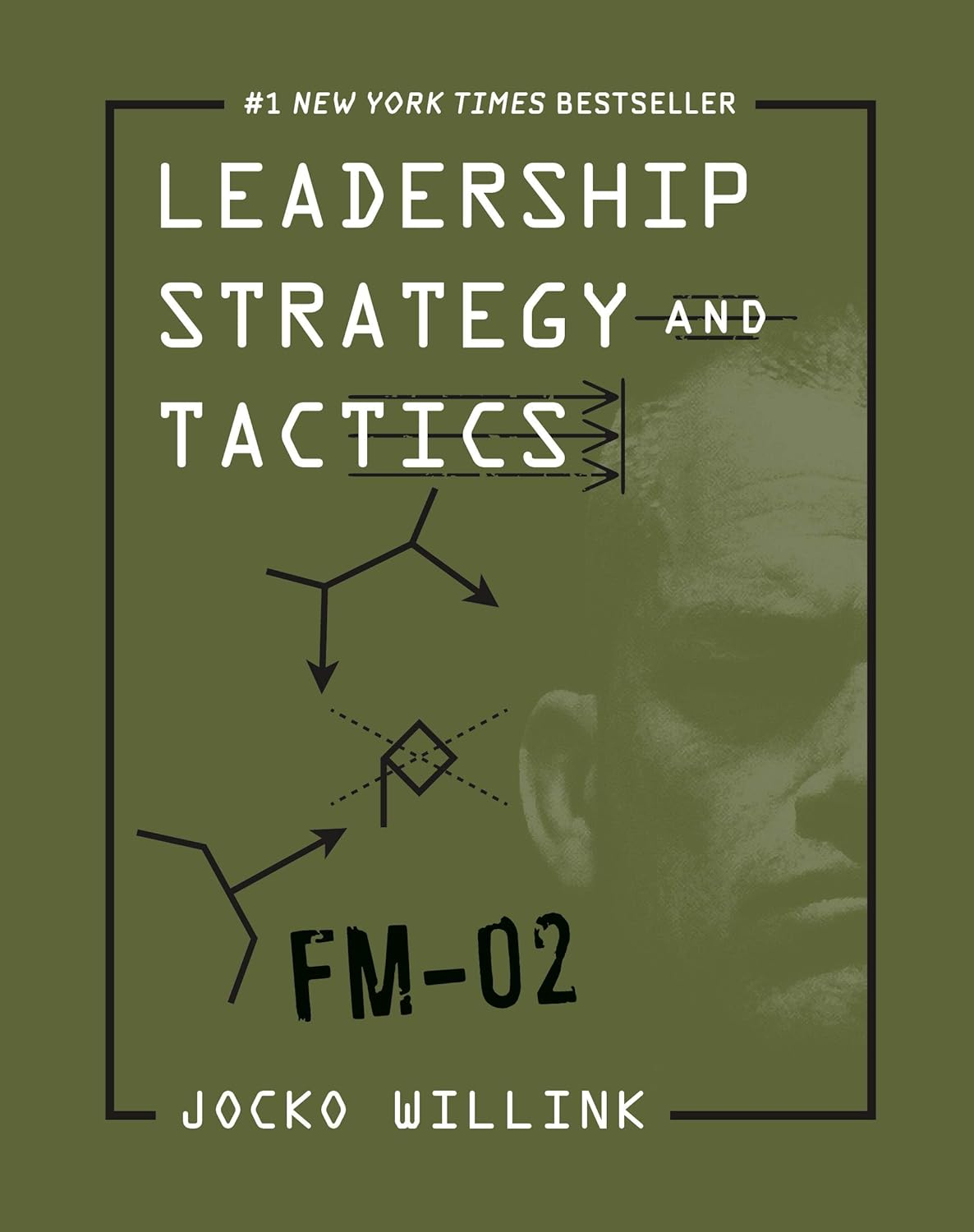
Leadership Strategy and Tactics: Field Manual
Jocko Willink’s Leadership Strategy and Tactics: Field Manual strips leadership of its comforting abstractions and presents it as a discipline forged under pressure. This is not a book about inspiration or charisma. It is a book about responsibility — unyielding, personal, and often uncomfortable.
Drawing from his experience as a Navy SEAL commander, Willink approaches leadership as a practical craft rather than a philosophical ideal. Decisions are made in environments defined by uncertainty and consequence, and leadership, in this context, becomes the ability to maintain clarity when confusion threatens to take over. The book’s tone reflects this urgency. It does not persuade through rhetoric, but through repetition, discipline, and hard-earned insight.
Central to Willink’s argument is the idea of absolute ownership. Leadership, he contends, begins and ends with accountability. When teams fail, leaders must look inward before outward. Authority, in this framework, is not granted by rank but earned through consistent action and visible responsibility. It is a demanding standard, one that leaves little room for ego or excuse.
What distinguishes Leadership Strategy and Tactics is its attention to the moments most leadership books avoid. Willink addresses the reality of enforcing standards, navigating internal conflict, and making decisions that will not be popular but must be made nonetheless. He treats leadership as a lonely endeavor, one that requires emotional restraint, moral clarity, and the willingness to absorb blame so that a team can continue to function.
The book’s utilitarian design mirrors its philosophy. It is meant to be consulted, revisited, and applied under stress. Yet beneath its tactical structure lies a broader message: leadership is not about commanding others, but about mastering oneself. Discipline, communication, and humility are not optional traits; they are prerequisites.
Leadership Strategy and Tactics: Field Manual does not promise ease or admiration. It offers something more austere and more valuable — a framework for those prepared to lead when circumstances are unforgiving and outcomes matter. It is a book for practitioners, not spectators, and for leaders who understand that the weight of command is carried quietly and paid in full.