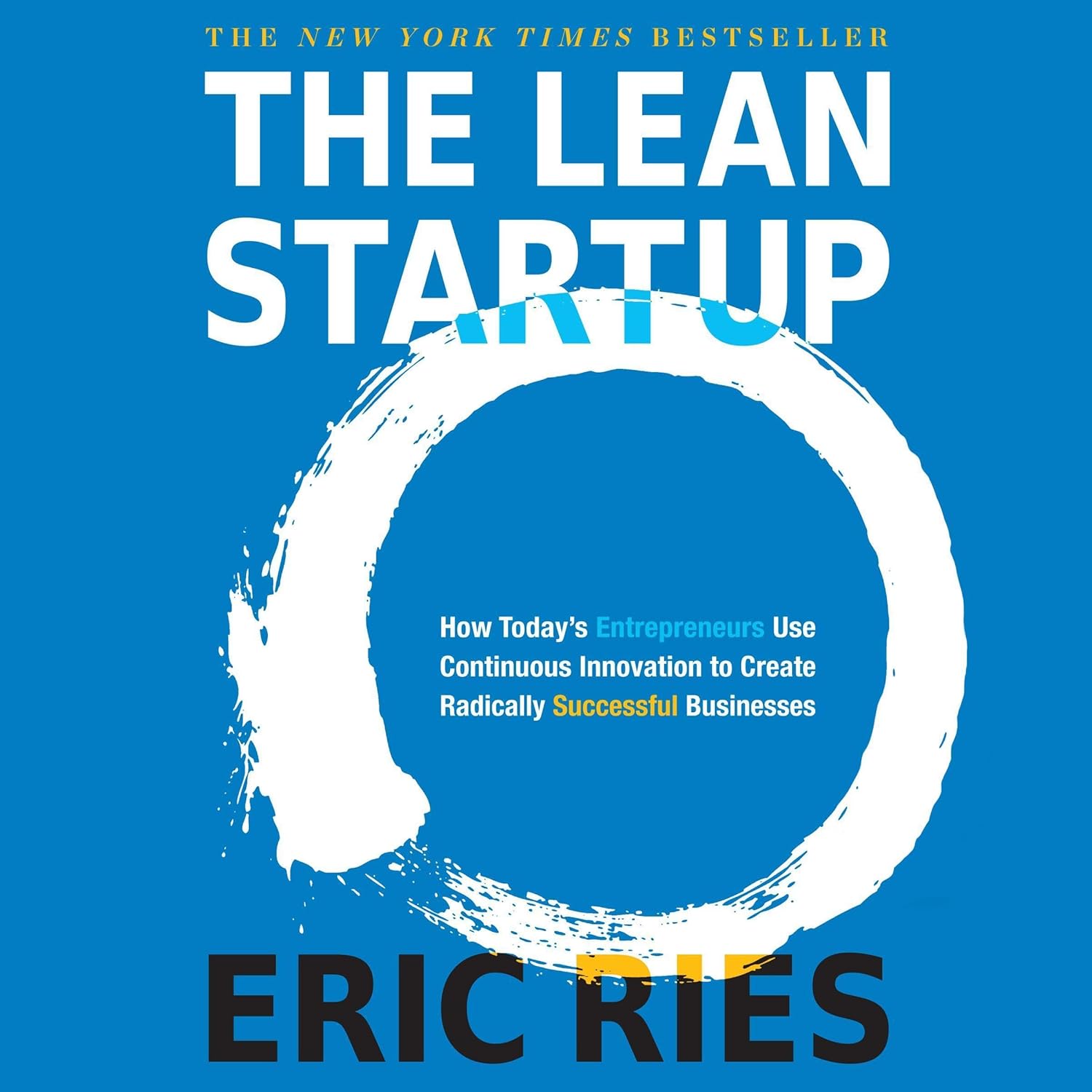
The Lean Startup: How Today’s Entrepreneurs Use Continuous Innovation to Create Radically Successful Businesses
Eric Ries’s The Lean Startup has become one of the defining texts of modern entrepreneurship, not because it offers a formula for success, but because it challenges the assumptions that have long underpinned how businesses are built. Its central premise is both disarming and consequential: most new ventures fail not from a lack of effort, but from building things that do not matter.
Ries reframes entrepreneurship as a process of disciplined learning. Instead of pursuing perfection behind closed doors, he advocates for an iterative cycle in which products are introduced early, measured rigorously, and refined based on real-world feedback. Progress, in this framework, is no longer tied to the completion of plans, but to the validation of assumptions.
What distinguishes The Lean Startup is its insistence on evidence over intuition. In uncertain environments, traditional planning becomes speculative at best. Ries proposes an alternative: treat every feature, every strategy, and every investment as a hypothesis to be tested. The now-familiar loop of building, measuring, and learning is less a methodology than a mindset — one that prioritizes adaptability over certainty.
Yet the book’s influence has also led to its simplification. Lean is often mistaken for speed alone, when in fact its emphasis lies in precision. A minimum viable product is not merely a stripped-down version of a product, but a carefully constructed experiment designed to elicit meaningful insight. Without that rigor, iteration risks becoming noise rather than learning.
Perhaps the book’s most enduring contribution is its redefinition of failure. In Ries’s view, failure is not the opposite of success, but an essential component of it — provided it yields knowledge. Startups do not collapse because they experiment; they collapse because they fail to learn.
The Lean Startup remains relevant because it speaks to a broader condition of modern work: uncertainty is no longer the exception, but the norm. In such a world, the ability to learn quickly, decisively, and honestly becomes the only sustainable advantage.