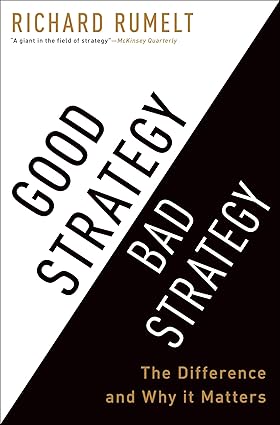
Good Strategy Bad Strategy: The Difference and Why It Matters
In Good Strategy/Bad Strategy, Richard Rumelt delivers a bracing critique of modern strategic thinking, exposing how much of what passes for strategy is little more than aspiration dressed up as analysis.
Rumelt’s central argument is disarmingly blunt: bad strategy is not the absence of ambition, but the avoidance of reality. It reveals itself in vague mission statements, inflated visions, and goals that substitute hope for diagnosis. Too often, organizations confuse strategic language with strategic thought.
What sets this book apart is Rumelt’s insistence that strategy begins with clarity about the core challenge. A good strategy, he argues, is anchored in a sharp diagnosis of the situation, followed by a guiding policy and a set of coherent actions. Without this intellectual discipline, leaders merely react, spreading resources thin while convincing themselves they are being strategic.
Rumelt’s concept of the “kernel of good strategy” strips the idea down to its essentials. There is nothing glamorous about it, and that is precisely the point. Strategy is not about elegance or inspiration; it is about focus, choice, and trade-offs. It demands the courage to confront uncomfortable truths and to say no to paths that dilute effort.
In an era saturated with management jargon and visionary rhetoric, Good Strategy/Bad Strategy reads almost like a corrective. It does not promise easy answers or universal frameworks. Instead, it challenges leaders to think more rigorously, to reason more honestly, and to take responsibility for their decisions. For anyone serious about strategy as a discipline rather than a performance, Rumelt’s book remains essential reading.